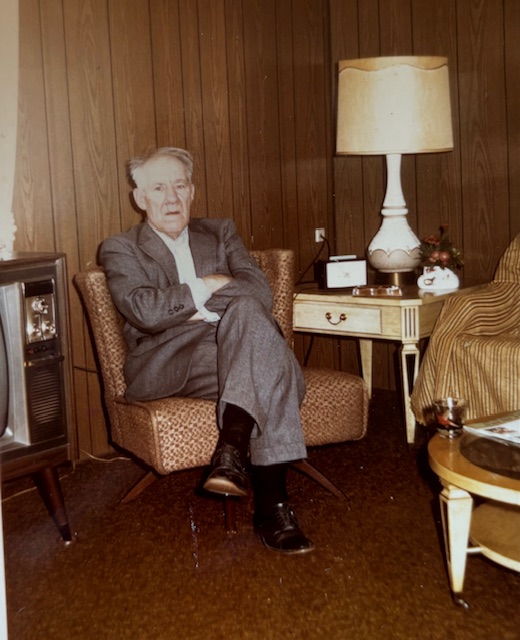
My father was a quiet man, content to float along on my mother’s ocean waves of talk. It wasn’t that he didn’t have anything to say. Dad was intelligent and loved to read at night, despite being forced to leave school after the eighth grade to help on the family farm. He devoured the State Journal every day and even read my older sister’s True Romance magazines when he was desperate. When he was a young adult, his parents sent him to Milwaukee to learn to be a mechanic. He used that knowledge to fix farm implements until he lost his right hand in a farm accident while clearing out a jammed corn picker. As a middle son in a family of six, Dad learned to view life from the sidelines, deferring to whoever was running the race. Sometimes his tranquility was welcome after the hectic pace of my mom. I knew Dad loved me, even if he didn’t speak of it very much.
My favorite memory of my father was going to the feed mill with him. On feed mill days, my dad would come in from the morning milking and say, “Who’d like to go with me to Friesland today?”

My brother, six years older, would rather go fishing with the neighbor boys. My sister, nine years older, would rather read her romance magazines. I was the eager companion ready to go to town with my dad.
Dad would load up the back of the pick-up with oats, or corn, whatever needed to be ground up at the feed mill. Dad opened the door to the truck and I hopped in. The musty smell of old oil clung to the leather seat, warm from the sun beating in through the windshield. I slid back on the seat but my feet didn’t reach the floor. My bare legs stuck to the leather while a trickle of sweat dribbled down. I cranked down the window, while Dad turned the key to the engine and the old pick up wheezed into action. We backed out of the driveway and we were off. Dad tuned in the radio to our local station—Rocking Robin was our favorite song. If it played, we knew it would be a good ride. I’d sing the lyrics and maybe Dad would softly “tweet, tweet, tweet’ on the chorus.

Cows munching on grass would ignore us when we whizzed past. The scent of alfalfa and freshly turned soil swept through the cab. My hair blew into my face, but I didn’t care. When Dad was done at the feed mill, it was a short stroll to Tina Tamminga’s store. In the 1950’s, Friesland had a population of about three hundred people featuring the feed mill, a small grocery store, a bar, two churches, Tina’s store, and a school. To a young farm child, Tina’s store was an emporium of delights, a combination of today’s convenience store and a soda shop.
Dad would unload whatever was in the bed of the truck in a large vat. From a window in the feed mill office, I’d watch the feed fill the burlap bags like sand rushing through an hour glass. Then Fred, the feed mill guy, helped Dad load up the truck with bags of feed. Hot and dusty, Fred heaved the big bags on the truck while Dad slid them toward the back of the bed. When Dad hopped down and put up the tail gate, it was time to go to Tina’s.
The dark coolness of Tina’s store was a welcome respite from the blazing hot sun. My eyes would blink for a few minutes until they adjusted to the dim light. Tina, wisps of grey hair escaping from her ever-present bun, would greet us. I’d politely say, “Hello Mrs.Tamminga,” like I’d been taught. She’d always say, “Call me Tina.” But I couldn’t bring myself to call a grown-up by their first name.
Her husband, who was severely handicapped, hobbled around in the background like a troll in a fairy tale. Sometimes he sat in one of the two gloomy wooden booths in the rear of the store, which never seemed to hold anyone but him.
“Don’t stare,” my dad whispered.
I tried to look anywhere but in the direction of the twisted misshapen man. My eyes lit upon the huge glass jars filled with penny candies; tart lemon drops, sugary orange slices, black licorice in the shape of babies, and little wax bottles filled with syrupy sweet liquid.
Tina stood behind a massive counter carved,with intricate leaves and swirls of flowers, her sturdy back reflected in a mirror behind her. Dad lifted me on a stool. Tina leaned forward and said, “What will you have today, young lady?”
Sometimes I would have a chocolate ice cream cone, or a fudgsicle, but most of the time I’d order a root beer float and so would Dad. The foam from the root beer would tickle my nose as I drank from the straw. Tina gave me a long-handled spoon to scoop out the ice cream. While I’d swirl it around to make it melt and turn the root beer into a creamy concoction, Tina would fill Dad in on the latest gossip. Occasionally, Mr. Tamminga would chime in with a few details. Before we left, Tina would let me pick out a piece of penny candy for the long ride home. I’d look over the jaw breakers and the paper filled with little candy dots. My favorite was the cool long stick of red licorice, cherry sweet. Dad would try to pay, but Tina always said, “Sweets for the sweet,” and wouldn’t take his penny.
The ride home would be even hotter, but I didn’t mind. I’d suck on my candy, finishing it long before we pulled into the driveway. No need to worry about sharing with my brother or sister. They had their chance to ride to the feed mill with Dad.
When did I stop going along with Dad? It must have been when I started reading. I compulsively read every book I could get my hands on. Once I entered the book’s world, not even the promise of candy and a root beer float could make me leave it until I turned the last page. Did Dad miss me? I’ll never know, because like I said, he was a quiet man. He didn’t talk much about his feelings.
 Janice Detrie