“Nothing turns out quite in the way that you thought it would when you are sketching out notes for the first chapter or walking about muttering to yourself and seeing a story unroll.” – Agatha Christie
Three chapters from the end. That’s all that’s left to write on my next book, Murder at the Movies. I truly thought my last book, To Die for Pickleball, was it. I’m getting too old for this writing stuff. Words are slippery creatures that elude my grasp sometimes. I could be reading someone else’s book—someone younger as the majority of published authors are—and eating Lindt Chocolates. I’m never going to make the New York Times best seller’s list. Then Michael and I went to a movie and my murder mind kicked in.
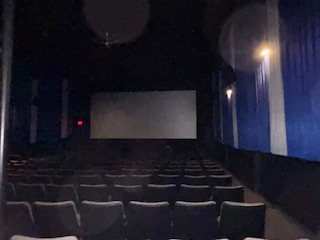
Picture a rainy September afternoon–too cold to walk outside. A bite in the air hints at the approach of winter. We decided to take in a matinee at our local theater, the Towne Cinema, a little gem built in 1913, converted into a triplex but still holding on to the features when movies ruled. A ticket booth, now unmanned by a mannequin. A brightly lit lobby adorned with whimsical sculptures composed of obsolete movie equipment. Current upcoming movies are intermingled with historical hits in glass cases. Movie quotes line the walls of the hall leading to the largest seating room which still has the stage where vaudeville troupes performed.

Michael and I were munching popcorn waiting for the trailers to begin when I looked around. All of five people occupied the seats. In the dim lights, I could barely make out their outlines, much less their gender. A person could die here and no one would know until the lights went back on. I snapped a photo with my camera and a murder mystery was born. I saw the victim, a well- dressed young woman, slumped in the next seat with her sleek blonde hair covering her face.
But wait! Why are a few bees buzzing around her? I hadn’t noticed any bees when I first sat down. Then her body rolls to the side. Her hair falls away from her purplish horribly swollen face. Anaphylaxis! A severe allergy to bee stings has killed her. How did the bees get in? The story begins.
The experience deepened my love for old movie theaters. I remember when my sister took me to the movies in Markesan, the small town closest to our farm. We saw Elvis in Jailhouse Rock, my first pop idol crush. What girl can resist Elvis snarling and twitching his hips? We cried through Old Yeller and stayed in our seats to watch it twice. I felt a little scared when the lights went down, but the action on the screen soon made me forget my fear as I got swept up in the story. Darkness in old theaters whispers of eerie happenings.


When I dug into the history of the Towne Cinema, I discovered its former name, the Classic Cinema, so in my book, It remained the Classic. The theater opened in 1913, and kept pace with new advances in the motion picture industry. “talkies” were introduced in 1928 and CinemaScope in in 1954, bringing the best of up to date ‘big screen’ entertainment to Watertown. In 1927, the Classic had the largest canopy marquee in the state of Wisconsin, extending 7 feet from the building and was 40 feet long. But widening Main Street forced the owners to remove it. When Hollywood converted to digital projection, the community got involved to save the Towne Cinema. In 2013, the people of Watertown raised over $70,000 to buy the new digital equipment. The price of a ticket today is $4.50, kept low due to community support.
In the Watertown Historical Society archives, the name of Oscar Baumann, manager of the theater for forty years appears several times. “Mr. Baumann has so long been identified with movie entertainment that he was like a fixture in the lobby. One looked for him and usually found him in or about the place.”* Except for the day in 1941 when Katherine Hepburn came to town enroute to Madison. She called at his office shortly before noon, but he was not there. So she had to talk to Mrs. Kramp of Sally Ann’s Bakery next door and left a note.
Oscar may have missed Katherine, but he didn’t miss finding the nearby dentist, R. J. Buss, in semi-conscious condition on his couch in 1933. When he and two other companions stopped to invite him for lunch, they found him near death. He was removed to the hospital and died. An investigation by the county coroner found he was poisoned. I thought this might be an interesting subplot, and searched the archives for any further information on a possible homicide, but drew a blank, so I moved on.
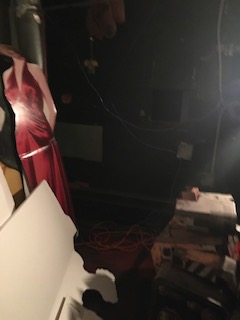
I called Matt Hanson, the current manger, and asked if I could have a look around and snap some pictures. Matt was a wonderful, gracious tour guide and ushered me up to the second floor, a treasure trove of spooky images: Long dark hallways, piles of boxes, coils of extension cords waiting to trip the unwary visitor, cut-out figures of actors from previous movies, the bottom torso of a naked mannequin, stacks of empty reels, and even a little balcony overlooking the back of the theater where the projectionist could watch patrons making out in the back rows.
But the best piece of the Towne Cinema is this little-known tidbit. Past employees of the Towne/Classic Cinema have encountered a mysterious figure, the man in the tan suit, on the second floor. Some believe it was Oscar, who loved the theater so much, he refused to leave. How could I resist writing this haunted specter into the mystery?
A wall of famous movie quotes leading to the main theater became an important part of the plot. When I started out writing the book, I envisioned an ending where Gaston discovered the source of the rather unusual bees in a back yard, and hence the killer. The Towne Cinema kept intruding on my thoughts and compelled me to set the climax on the second floor of a shadowy theater. As Douglas Adams put it, “I may not have gone where I intended to go, but I think I have ended up where I needed to be.”
*Courtesy of the Watertown Historical Society Archives
Watch for Murder at the Movies coming August, 2025.
 Janice Detrie